Watt's in a Name?
Picture this. A flight is boarding. The doors are about to close. A young woman walks up to the gate, holds up her press card, and tells the airline staff: I’m interviewing the minister. You don’t let me on this flight, you answer to him.
They let her on.
That woman is Nithya Balakrishnan. At the time, she was a business journalist at CNBC in Delhi, tracking the Vijay Mallya kingfisher collapse, getting called by ministers for Diwali parties, producing her own show called The Disruptors where she’d fly on the company’s dime to interview CEOs and look glamorous on air.
Today, she runs marketing and communications for a clean energy company most people have never heard of.
We hadn’t either.
After we published our first piece about The Whole Truth Foods, a message landed in our inbox. “Hi, hope all is well! Just wanted to reach out and say I like what you have set out to do... especially the bit about honest storytelling of authentic brands.”
“There’s a powerful story here,” she wrote. We believed her.
It was from Nithya Balakrishnan, Head of Marketing and Communications at Fourth Partner Energy. We looked them up. They’d executed over 3,000 solar and wind projects. Their clients included Coca-Cola, Nestlé, HUL, Schneider Electric, Walmart, Pepsi. Norway’s sovereign wealth fund had invested equity. So had the IFC, the Asian Development Bank, and Germany’s DEG. Their installed asset base was 1.5 gigawatts across 24 states.
And yet: if you say “clean energy in India,” the names people know are Adani, Renew, Suzlon. The story ends there.
We got on the call expecting 45 minutes. We stayed for 90.
Three guys, a beer, and a tissue paper.
We started where everyone starts: the name.
Fourth Partner Energy. It doesn’t say solar. Doesn’t say wind. Doesn’t say anything about clean energy. It sounds almost... random.
Kind of. But not the way you’d think.
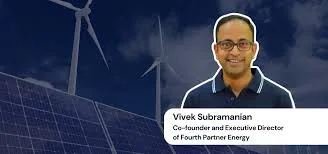
In 2010, three friends sat down over drinks. Vivek Subramanian, Saif Dhorajiwala, Vikas Saluguti. All three had been venture capitalists. They’d sat on boards, advised companies on strategy, the whole nine yards. But the itch to build something themselves was eating at them. They dabbled with an idea of a cricket-centric business, turning passion into a profession but quickly nipped it in the bud.
Solar was barely a market then. No boom. No government push. Just a sense that there was something there, if you were patient enough.
The legend goes that the first logo was sketched on a tissue paper at whatever bar they were at. And while they were tossing around names, somebody said: we’re three. But everyone we meet on this journey – the people we hire, the people who buy from us, the people who fund us – they’re all going to be our partner too. Our fourth partner.
That was 15 years ago.
What followed was $500+ million in total funding, an asset base of 1.5 GW, operations across 24 states, and a target of 9 GW by 2031.
Today, there’s a woman named Kajal Didi who distributes chai at their original office in Tarnaka, a neighbourhood in Hyderabad. She has ESOPs. Actual stock options. Has had them since nearly the beginning. It’s not going to buy her a bungalow in Jubilee Hills, Nithya said, but it’s enough that she can do her kid’s wedding the way she wants to.
Every single employee at Fourth Partner has stock options on the books. It’s publicly spoken about. It’s not a talking point. It’s how the place runs.
The anti-FOMO company.
Their first real projects were solar lanterns and irrigation pumps. Rural India. Places where the grid didn’t reach. Then came a batch of rural ATMs for ICICI – the machines kept crashing because there was no steady power. Fourth Partner put tiny solar installations on top of them. We’re talking kilowatts here. A thousand kilowatts make a megawatt. A thousand megawatts make a gigawatt. They were at the very, very bottom of that ladder.
The founders were clear about the philosophy from the start: “No cash burn. Build execution capabilities. Grow when you’re ready.”
They hired four or five people, all local Telugu speakers, because the first push was Andhra Pradesh. (All of them still work at Fourth Partner, 15 years and counting). They did the governor’s residence in Hyderabad. A few small corporates across two or three cities. And then they paused and looked at what they’d learned before doing anything bigger.
This is where the story splits from most startup narratives. There was no raise-big-scale-fast energy. The founders had been venture capitalists. They’d sat on the investor side of the table and watched companies fly before they could walk. They didn’t want to be one of them.
By 2015, solar had become a real market in India. The pitch got simpler. You’re paying ₹11 per unit from the grid. We’ll give you solar at ₹7. We install everything. You pay us per unit consumed. No upfront capital. No maintenance headache.
What changed? Was it a sudden awareness about the environment at large?
Nithya laughed about the environmental angle: in 2015, nobody in India was buying solar to cut carbon. “Doing good for the planet, protecting the environment – nobody really gave a damn. The reality was: you’re going to save 30 to 50 percent on your electricity bill. That was it.”
In 2018, TPG Capital’s impact investment arm put in $70 million. That opened the doors to Bank of America’s first rooftop solar credit line in Asia. Then Norfund. Then IFC, ADB, and DEG at $275 million. These are development finance institutions that usually lend money for projects – come in, build the asset, get out. With Fourth Partner, they invested equity. Long-term skin in the game.
And through all of this, there was a specific kind of discipline that kept them on track. They never chased residential solar. They watched other companies race for volume, undercut tariffs, chase government tenders. Fourth Partner stayed in the commercial and industrial lane. Good clients. Clean books. Reliable payments.
“We never felt FOMO,” Nithya said. “Others are doing gigawatt after gigawatt? Fine. We go to good clients, execute the right way, and see what follows.”
What followed was $560 million in total funding, an asset base of 1.5 GW, operations across 24 states, and a target of 3.5 GW by next year.
The year everything stopped.
By 2019, they’d started expanding internationally. Indonesia through a joint venture with the country’s largest thermal producer. Sri Lanka, Bangladesh, Vietnam – markets they figured were where India had been five years earlier.
They’d just broken ground on their biggest project: a 100-megawatt solar park in Uttar Pradesh.
Then: lockdown.
Suddenly their people were scattered across countries. Execution timelines blew out. Sites were inaccessible. The commercial and industrial clients they depended on weren’t consuming power because their own operations had slowed.
“Not a single person was laid off,” Nithya said. She was firm about this. “Not one.”
The senior leadership – what they call the management committee and executive committee – agreed to defer their own increments. Everyone else got theirs. And even within the senior group, if someone genuinely needed the money, they could go to HR privately and get it. No questions, no judgment. When the pandemic ended, all the deferred arrears came through.
Nobody made a press release about it.
What they did make was a set of realizations. Productivity hadn’t dropped during remote work. People had shown up, paid for their own internet when they needed to, kept things running. And the company learned something it carried forward: that flexibility could be real, not just a policy on paper.
Work-life balance. A myth or a reality?
The instances of increased accountability led the firm to sit up and redefine a ‘good’work ethic. Did 8-10 hours a day in office result in better performance; or could leaders carve out what worked best for their respective teams, based on the nature of their jobs. What role did empathy play in leadership and getting the best out of a colleague? Tough questions that resulted in a world of learning for the firm.
Could life happen alongside a meaningful, fulfilling career? Someone wanted to work remotely for a year after having a baby. Someone else needed six months away to care for a grieving parent. Each time, the conversation was the same: do you have a committed work plan? Will you stick to it? This was decentralised decision-making at a grass-root level.
The company doesn’t have designations. Just three levels for 500-plus people: executive committee, management committee, and future leaders. No deputy manager, senior deputy manager, associate deputy deputy manager. The firm realises there could be a flip side – people sometimes feel like they’re not growing because there’s no title to chase. Fourth Partner’s answer is: look at your work. Look at what you’ve learned. Look at whether your career has moved. The firm is committed to recognition, appraisals and annual increments. They just won’t give you a fancier visiting card.
They do reverse appraisals. Anyone can give feedback to anyone, including the founders. Town halls where if you don’t participate, they’ll pull your name and make you say something before you leave.
But Nithya was also refreshingly direct about where the flexibility ends. If you’re 23, no kids, healthy parents, no dependents – you’re in the office five days a week. Full stop. “Don’t come to me at 23 wanting your gym class at 10 AM. In my matrix, a new mother or a young father with an ill parent will always take priority over your gym class. And you should be okay with that.”
Expectations set on day one. And because they’re set, nobody resents the system.
The journalist who switched sides.
Let’s go back to Nithya for a minute.
She was consulting for Fourth Partner when Vivek, the co-founder, looked at her CV, looked at the CNBC clips, looked at the show she was producing, and said – in his words, which she refused to soften – “What the hell are you doing here?”
He meant it as a compliment, sort of. Why was someone with her profile sitting across from him for a consulting gig? He wanted her full-time. He told her he’d create something for her.
She said yes.
And then spent a while wondering if that was stupid.
“In journalism, you’re front and centre,” she told us. “In marketing, you’re behind the screen. It’s always you writing, but somebody else’s name goes on it. Your team shape’s the firm’s narrative, but is rarely a part of that narrative. You’re clubbed with HR. You’re the ‘team.’”
She’d go back to her old CNBC colleagues and arrange for them to interview her boss. She knew it was the right move for the company. But sitting in the room while someone else held the microphone? That stung.
And she was honest about something else: she always knew the power she’d had as a journalist belonged to the card, not to her. The press credential opened the doors. The designation carried the weight. It was an easier pill to swallow than if she’d believed it was personal. But it was still a pill.
We’ll hold the ball.
We asked Nithya the question we try to ask in every one of these conversations: is there a moment from this journey you’re still sitting with? Something you haven’t fully processed?
She went quiet.
Then she told us about what maternity does to women in broadcast journalism. She’d seen it up close. Three senior journalists in her bureau, one by one, had babies. And one by one, they stepped back from prime time. They couldn’t be on camera the way the network expected. And Nithya – 21, hungry, on fire – stepped into the gaps they left.
“It was never the intention. But that’s how things played out.”
Years later, she was the one having a baby. At a clean energy company in Hyderabad instead of a newsroom in Delhi. And the difference hit her like a wall.
“They said: we’ll hold the ball till you can come back. We’ll find where you fit. If someone rises to the occasion while you’re away, we’ll figure out something else for you to do. But you go be where you need to be.”
She was remote for a year. Then two hours in office. Then three. Then half days. She compensated on weekends when she had to. Her leadership wasn’t taken away.
“Would this have happened in television journalism?” she asked. The question answered itself.
And the thing that really got to us: two years ago, Pallavi Saxena, a fellow marketer at Fourth Partner decided to have a second child. She’d taken a sabbatical after her first baby, eight years earlier at a different company. But she’d watched how maternity could be handled at Fourth Partner and thought: maybe I can do this differently this time, maybe there would be no pause button. The marketing team rallied to work something out. They did. She’s back at her desk. The baby is two. Her older child is ten.
One person’s experience became permission for the next and the path for others. That’s not a policy. That’s a culture propagating itself.
Every first.
We asked which project, out of thousands, she was proudest of.
“Every first,” she said. No hesitation.
Their first ground-mounted solar plant in Andhra Pradesh – 10 megawatts for Bharti Cement in Kadapa. The first airport installation at Tirupati, where they had to figure out shadows and angles on a complex rooftop. A dome-shaped roof for a corporate client that looked like a planetarium – nobody had put solar panels on anything like it. Building-adjacent photovoltaic panels for a school in Noida where they embedded solar into the walls. Floating solar on reservoirs in Odisha. The first wind-solar hybrid in Karnataka.
And the one that’s still being commissioned: India’s first commercial interstate transmission system project for corporate clients. They’re generating solar in one state and sending it to consumers in another.
“Kerala doesn’t really yield itself to renewable energy generation. But you can still generate in Telangana and ship it to a consumer in Kerala. That’s what we’re doing.”
Phase one is in Karnataka. The government is adjusting policies in real time as Fourth Partner figures out the execution. First-of-its-kind projects are like that. You’re building the road while driving on it.
Calling a spade a spade.
One thing Nithya said that stuck with us was about their international markets. They’d gone into Sri Lanka, Bangladesh, and Vietnam with real conviction. They thought those markets were where India had been five years prior and that the playbook would transfer.
It didn’t. Not fully. Geopolitical instability, unfavourable policy shifts, markets that weren’t maturing the way they’d hoped.
“We’re very clear that you make mistakes, learn from them, and call a spade a spade. We didn’t exit in a hurry. We gave it time. But we’re now looking at exiting those markets.”
Indonesia is the exception – a 50/50 joint venture with the country’s biggest thermal producer that’s working well. Everything else, they’re willing to walk away from.
We liked that she told us this. Most companies on a call like ours would have glossed over it or buried it in corporate language. Nithya just said it.
After we hung up.
We sat with it for a while.
Nithya said something about the industry that we think explains Fourth Partner’s absence from the usual headlines: “It’s become a very commercial exercise, getting written about. Conferences, panel discussions, thought leadership – you buy your way in. At Fourth Partner, we don’t play that game.”
And then, almost as an afterthought, she added that the founders believe the work should speak for itself. And that believing that, in this industry, is “a little bit stupid.” She used that word. Stupid. With a kind of affectionate resignation, like she knows they’re right and also knows it makes her job harder.
So here’s us, doing the one thing we can: telling the story. The one they won’t pay to have told.

About the author
Shaili Contractor
She reads, constantly, about everything, in a way that makes her annoyingly good at spotting trends before they have names. Studied at Asian College of Journalism. Has spent 18 years turning messy briefs into brand stories people actually remember. She also spends her weekends on cleanup drives in her city because clarity matters everywhere, including the streets.
Stay in the loop
New pieces, when they're ready.
No newsletters. Just a note when something worth reading goes live.