The Most Valuable Content Never Goes Viral
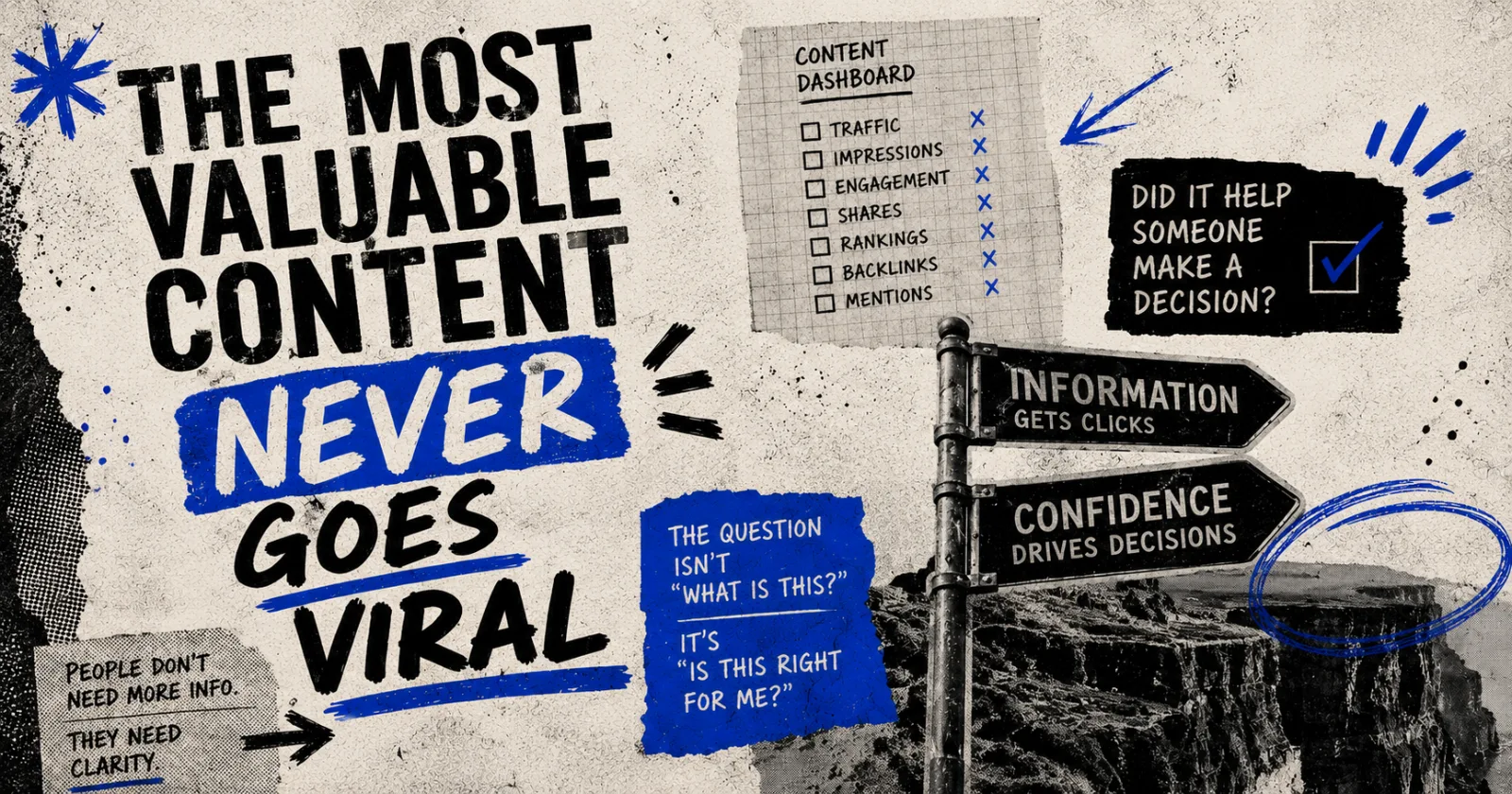
One of my favourite content metrics is also one that almost never appears in a content dashboard.
Nobody has built a quarterly OKR around it nor presented it in an all-hands. I've certainly never seen it highlighted in green on a performance review.
It is simply this: Did the content help someone make a decision?
Not discover something. Not spend another three minutes on a page. Not contribute to a upward-trending graph. Did it help them decide?
I've been thinking about this a lot lately because content teams, myself included, have spent years celebrating traffic, rankings, impressions, shares, backlinks, mentions, engagement rates and every other metric that can be neatly exported into a spreadsheet. None of these are bad metrics. Most of them are useful. Some of them are essential. But they are often several steps removed from the reason businesses create content in the first place.
A few years ago, if you'd asked me to identify the most valuable content assets in a content-to-commerce business, I would probably have pointed to the obvious candidates. Destination guides. Seasonal campaigns. City itineraries. Best of. The big pieces of content that attract large audiences and introduce people to a destination or experience.
Today, I'm not convinced.
The more time I've spent working on content that sits closer to a purchase, the more I've realised that value and visibility are often entirely different things. Take a company like NerdWallet. Their mortgage calculators, loan explainers and credit card comparison pages are hardly the sort of content that gets passed around WhatsApp groups.
Yet these pages sit astonishingly close to revenue. They appear when somebody is trying to make a financial decision.
The same thing is true of Wirecutter.
Wirecutter is described as a product review site, but I think that's missing the point. People visit because they're tired of researching. They've already opened twelve tabs, read dozens of reviews and watched endless videos. They're suffering from the uniquely modern problem of having too much information and not enough certainty. Wirecutter's real product isn't information. It's confidence.
Inspirational pages answer questions like what to do in Paris, how to spend three days in Rome, best places to shop for sarees in Bangalore, or where to get Laal Maas in Jaipur. They introduce users to options and bring in traffic.
But decision-making happens later.
When somebody is comparing two Vatican tours that look almost identical, or wondering whether a skip-the-line ticket is genuinely worth paying for. Or whether they should get beer at Brewery 1 or Brewery 26.
These aren't glamorous content problems. Nobody gives conference presentations about pre-booking guides or wins awards for excellent Pale Lager comparisons.
Yet these are often the assets doing the heavy lifting.
People often talk about discovery platforms as though they're in the business of helping people find things. That's true, but only partly. The best restaurant recommendation wasn't valuable because it introduced you to a place. It was valuable because it ended the search. You had somewhere to go on Saturday night. Decision made.
That distinction matters because much of the internet has spent the last twenty years solving for information. We built search engines, recommendation systems, directories, marketplaces and content ecosystems designed to help people discover more.
Now we're facing a different problem. People don't need more information. Most of the time, they need less. Or rather, they need help understanding which information matters.
This is partly why I remain unconvinced every time somebody announces that AI will destroy content. AI is already very good at providing information. It can explain what the Louvre is, tell you when it was built and summarise its history in seconds.
The hard problem is helping somebody decide whether spending six hours there is the right use of their limited time in Paris.
The harder problem is understanding context. Who are they travelling with? How interested are they in art? Is this their first visit? Do they have children? How much walking are they comfortable with? The difference between information and judgment is becoming increasingly important.
One is abundant. The other remains surprisingly scarce.
Which brings me back to content teams.
I sometimes think we've accidentally trained ourselves to optimise for attention because attention is easy to measure. Usefulness is much harder.
Traffic appears in dashboards. Confidence doesn't. Impressions appear in reports. Decision-making doesn't.
Trust usually shows up much later, disguised as conversion, retention or loyalty.
The irony is that some of the most commercially valuable content I've worked on over the years would look thoroughly unimpressive in isolation. A comparison page. A product explainer. A pre-booking guide. An FAQ. Content that nobody remembers reading because it quietly did its job and got out of the way.
Perhaps that's why these assets are so frequently overlooked. They're not designed to be memorable. They're designed to be useful.
And while the content industry remains obsessed with reach, engagement and visibility, I suspect the businesses creating the most value will continue investing in content that helps people answer a far simpler question. Not "What is this?" But "Is this right for me?"
The first question attracts attention. The second one drives decisions. And decisions, more often than not, are where the money is.

About the author
Aakanksha Singh Devi
She reads like she’s preparing for an apocalypse where books become currency. She writes the same way too – obsessively, analytically, occasionally at 2AM with seventeen tabs open and three contradictory thoughts fighting for survival. She watches F1 and football with an intensity that should probably be directed at something more productive. Like climbing mountains. Reads romance novels without apology. Once had a Bedouin propose to her in a desert in Jordan. She said no. Thinks about the sunset often.
Stay in the loop
New pieces, when they're ready.
No newsletters. Just a note when something worth reading goes live.