Brand Strategy vs Brand Identity: Your Logo and Font Type Is Not a Strategy
I keep seeing people confuse brand strategy with branding. But I think there’s a bigger problem: a lot of what we call brand strategy isn’t strategy either. A colour palette isn’t strategy. A logo isn’t strategy. A tone-of-voice document isn’t strategy. And “we want to be the most trusted, innovative, customer-centric brand in our category” definitely isn’t strategy. Because, well, who doesn’t?
The problem isn’t that any of those things are useless. They’re not. The problem is that we’ve started using brand strategy as a catch-all for almost everything a brand does, from deciding what it stands for to choosing the shade of green on its website.
Those are very different jobs.
Strategy is a choice, not a description
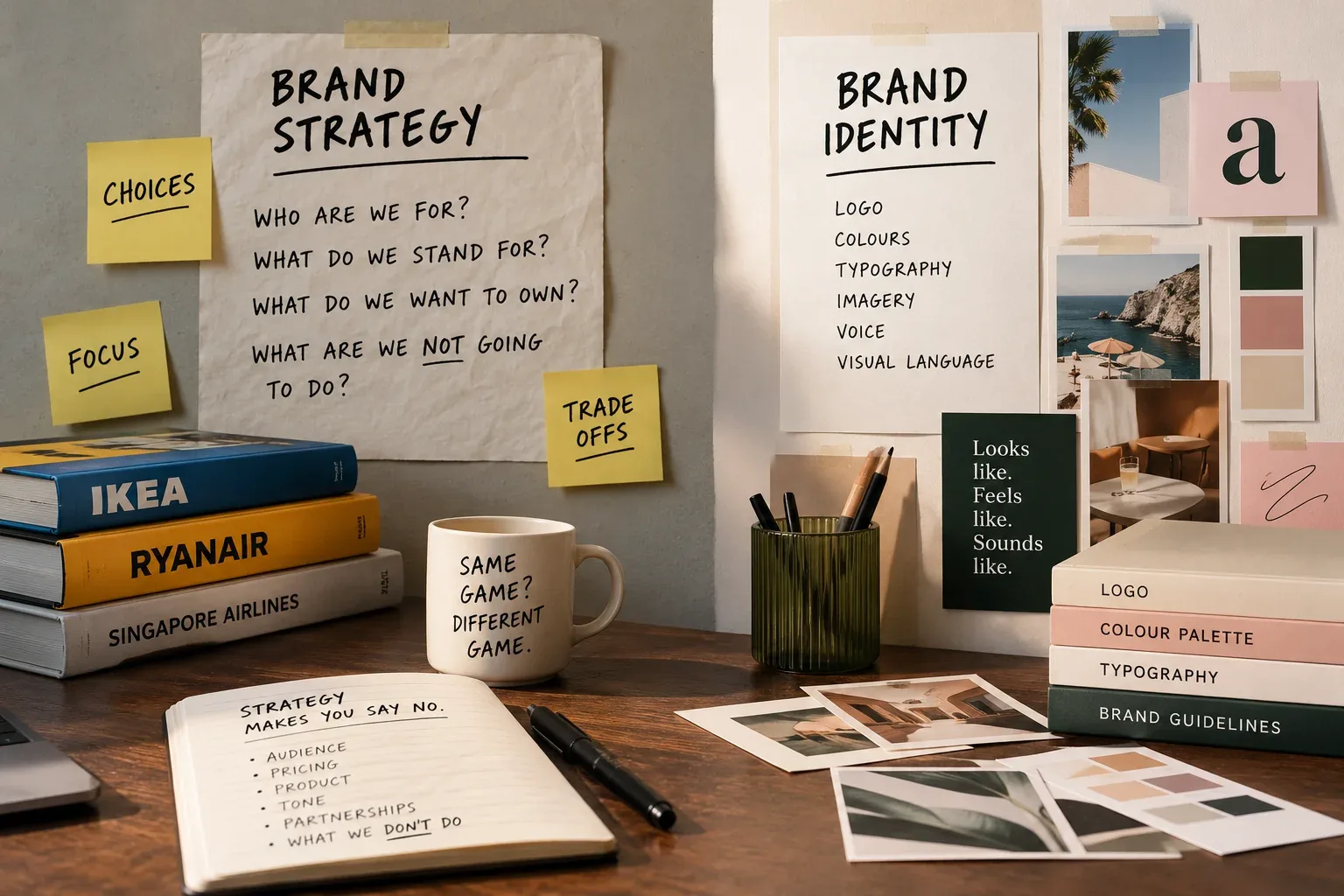
At its simplest, strategy is about deciding where you’re going to play, how you intend to win there and what you’re prepared to give up in the process. Yes, give up. Because a strategy that accommodates every audience, every product, every price point, every trend and every possible opportunity isn’t strategy. It’s not even a good temporary plan. It’s plain chaos!
Take IKEA.
Its strategy isn’t blue and yellow. It isn’t enormous stores or Swedish product names I have absolutely no hope of pronouncing correctly. Those are things we recognise about IKEA.
Underneath them is a much more consequential choice: make good design accessible at prices ordinary people can afford.
Once you make that choice, other decisions follow. Furniture is flat-packed. Customers assemble it themselves. Products have to be designed with manufacturing, storage and transportation costs in mind. The stores work differently from a traditional furniture shop.
There are trade-offs everywhere. That’s what makes the strategy useful. It doesn’t sit in a presentation describing the company. It actively changes what the company does. IKEA is not even attempting to be luxury or premium. It’s a decision they made. And clearly, it is working well. The salmon at the Bangalore outlet could be better though.
A useful strategy should make some decisions easier
This is probably the simplest test. Imagine someone walks into a meeting tomorrow with a new product, campaign, partnership or audience they want the brand to pursue. Can your strategy help you decide whether you should? If the answer is always “yes, potentially”, you may have a problem.
Ryanair is my favourite example for all things brand. Unhinged on social media. No nonsense off it. You may not like the brand. You may have had a deeply personal disagreement with its cabin baggage policy. But you understand the proposition. Low fares win.
That choice affects the service, the routes, the aircraft, the extras, the customer experience and the expectations the brand sets. Even if it means you didn’t get a window seat when you paid for one because the aircraft simply had a different seating arrangement!
Ryanair isn’t trying to be Singapore Airlines. And Singapore Airlines isn’t lying awake at night wondering whether it should become Ryanair. Thank goodness for that as well. They’re playing different games. That’s what a strategy should make clear: what game are we playing, and which ones are we deliberately not playing?
This is why so many brand strategies sound identical
Take a fairly standard line from the imaginary corporate strategy generator: We deliver exceptional experiences through innovation and customer-centricity. Excellent.
What decision does that help you make? Who does it exclude? What are you prioritising over something else? What would you refuse to do because of it? More importantly, could your closest competitor paste exactly the same sentence into their presentation without anybody noticing?
If they could, it’s probably not strategy. It’s corporate Mad Libs.
Words such as innovation, trust, quality and customer-centricity aren’t inherently bad. But simply wanting those things doesn't establish a position. You still have to decide what they mean for this particular business, for this particular customer, in this particular market.
Otherwise, you’ve described a collection of desirable qualities rather than made a strategic choice. It’s helpful when making a list of words to not use though. Ask me, I’ve been an editor for close to 20 years and I’d be more than happy to add it to my “List of Banned Words”.
So where does brand identity fit?
This is where the distinction gets muddled. And fairly so. Brand identity is how some of that thinking becomes recognisable. Your name. Logo. Colours. Typography. Imagery. Voice. Visual language. That Nike Swoosh, the red and white of Coca Cola. And the Levis logo (remember the clever branding they did at the FIFA World Cup 2026!).
These things matter enormously. Anyone who has seen a company destroy a perfectly good identity in the name of a “refresh” knows they matter. But identity and strategy aren't interchangeable. You can have a beautiful identity sitting on top of absolutely no idea. We see it all the time. Gorgeous packaging. Impeccable typography. A beautifully designed website. And after five minutes with the brand, you still have no idea why it exists, who it is really for or why you should choose it over the six other beautifully beige brands next to it.
Strategy gives the brand something to mean. Identity gives that meaning a recognisable form.
Ideally, the two reinforce each other. The identity shouldn’t be decoration added once the serious thinking is finished. It should make the strategic idea easier to recognise, remember and experience.
And branding is bigger than both
There’s another distinction worth making because this is where things get interesting.
People don’t ever see your strategy deck. They certainly don’t “experience” it. They experience your brand. They experience the product they bought. The website they tried to navigate. The packaging that arrived. The person who answered the phone when something went wrong. The refund policy. The store. The social post. The delivery experience. The email telling them their complaint is very important while leaving them on hold for 47 minutes.
All of those interactions teach people something about the brand, whether you intended them to or not. Which is why a beautifully articulated strategy means very little if the actual experience repeatedly contradicts it.
You can write premium in a deck 46 times. If the product arrives badly packaged and customer service disappears for a week, the customer has developed their own brand strategy for you.
And theirs wins.
The brand exists outside the brand team
This is the part I think gets overlooked when branding becomes primarily a marketing conversation. A brand isn’t built exclusively through communications. Pricing, product decision, hiring, partnership, customer service (definitely) builds it. The things a company refuses to do build it too.
Marketing can communicate the idea, but it cannot indefinitely compensate for a business behaving differently from the story it tells about itself. That’s also why the strongest brands often feel unusually coherent. Not because someone has policed every Instagram caption into submission, but because enough decisions are being made from the same underlying idea. You start recognising the logic.
Start with the harder question
There’s nothing wrong with asking what your brand should look like. Eventually, somebody absolutely needs to decide the font. But I wouldn’t start there.
Before the moodboards and colour palettes and debates about whether the brand is “playful but authoritative”, there’s a less glamorous question worth answering:
What are we willing to say no to? Which customers aren't we chasing? Which opportunities don't make sense for us? What aren't we going to compete on? What are we willing to be worse at because something else matters more?
Those answers are harder. They’re also far more likely to tell you whether you actually have a strategy or you need to call in The Story Shapers!

About the author
Aakanksha Singh Devi
She reads like she’s preparing for an apocalypse where books become currency. She writes the same way too – obsessively, analytically, occasionally at 2AM with seventeen tabs open and three contradictory thoughts fighting for survival. She watches F1 and football with an intensity that should probably be directed at something more productive. Like climbing mountains. Reads romance novels without apology. Once had a Bedouin propose to her in a desert in Jordan. She said no. Thinks about the sunset often.
Stay in the loop
New pieces, when they're ready.
No newsletters. Just a note when something worth reading goes live.