Raising the Bar
The internet in central London is, apparently, terrible.
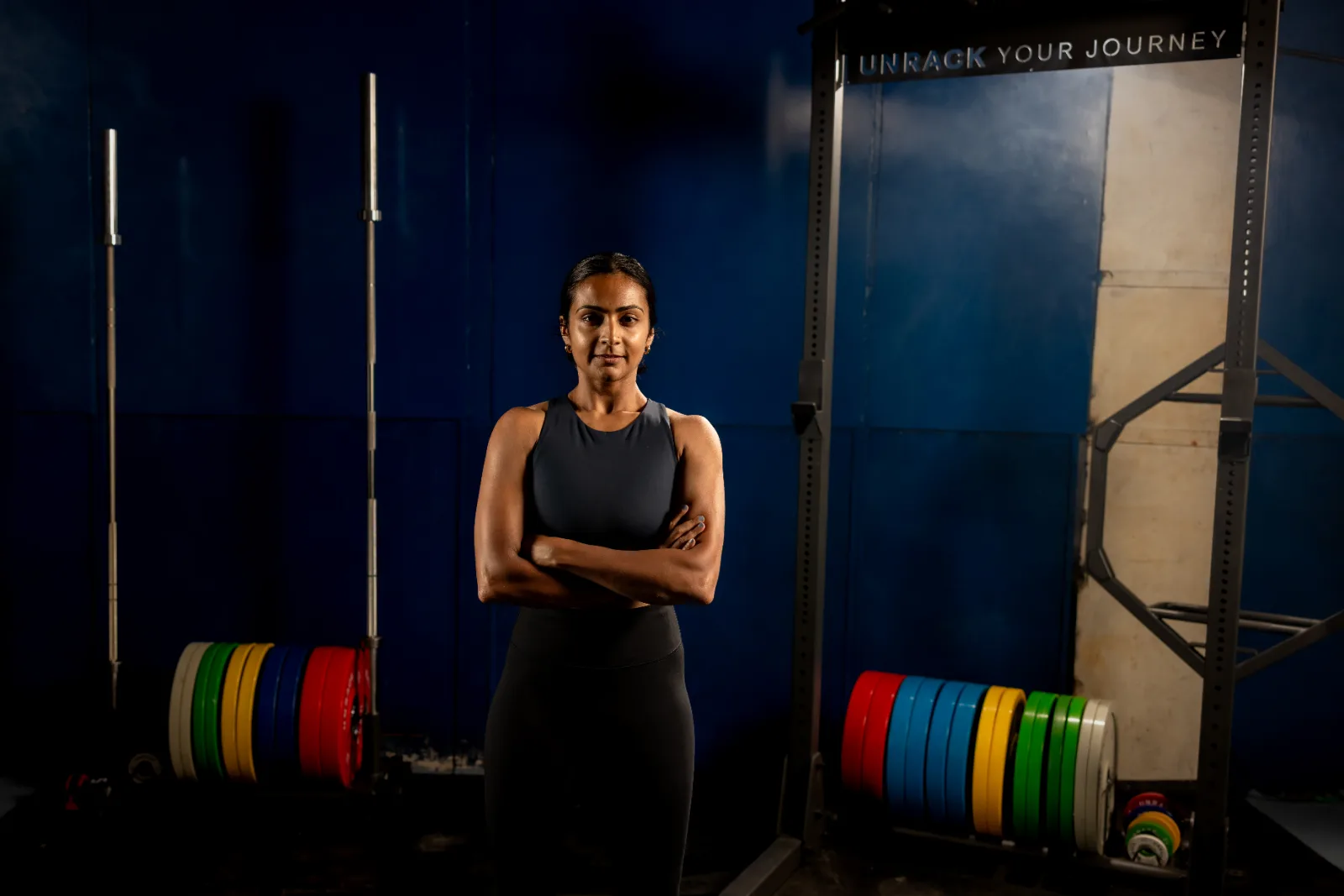
We’re trying to get on a call with Sahana Gopal, founder of Unrack, a strength equipment company based out of Bangalore. She’s frozen mid-sentence for the third time in ten minutes. Switches from phone to laptop, moves rooms, comes back. “You wouldn’t believe it,” she says, laughing, “but the network in central London is just absolutely shocking.”
It’s 12:30 PM her time, evening out time. We’d found our way to Sahana through a mutual connection, and we’d come in armed. We’d read the Hindustan Times feature by Sharda Ugra. We’d gone through TechThrive’s deep dive. We’d scrolled through Unrack’s Instagram, pored over product specs, and watched conference footage. We thought we knew the story.
We didn’t, really.
She calls herself a pivot queen.
Sahana grew up a junior national badminton player in Bangalore. She wanted to be a doctor but froze in every med school interview. Her supervisor nudged her toward a PhD, and she ended up at Imperial College London—her fourth degree—studying how stem cells interact with engineered biomaterials.
Her thesis title sounded like it was generated by a very serious algorithm: “New strategies for detailed visualisation and analysis of stem cell-material interactions.”
In plain language: nano-needles, deadly chemicals, and microscopes that let you watch how stem cells behave on engineered surfaces. “Open them, your lungs are fixed and you’re dead,” she said about the chemicals, as casually as if she were describing a dodgy sandwich she'd had for lunch.
She finished her PhD. But five years of isolation did something to her.
She paused.
“Because all the kids who did a BSc went off and became consultants and walked around appearing like they know everything about the world. And you’re sitting there thinking... I’ve spent five years answering a question nobody cares about.”
“Have you been to college?”
While writing up her thesis, Sahana had been coaching on the side. It started with a fellow UCL badminton player named Gina Bland and grew through word of mouth. She’d torn her own ACL years earlier, fallen into strength and conditioning during rehab, and never let go. Her genetics background made the science easy. The coaching itself, how to stand in front of an athlete and adapt in real time, she was figuring out as she went.
In 2018, a man named Gareth Ziyambi spotted her training clients in a London gym. Ziyambi was head physio for British Diving, Tom Daley’s physio, and he had young female divers entering the UK Sport elite programme who needed strength work. He cold-contacted Sahana and asked her to join his team.
The pairing was unusual. He was Zimbabwean, she was Indian. Two outsiders in an overwhelmingly white, overwhelmingly male world. The Hindustan Times later called her 'an even rarer kind'—an Indian woman, 5'2", in the weight room with Olympic athletes. They weren’t wrong.
She said yes. “I knew I didn’t want to be in a lab all my life.”
What followed was seven years with Team Great Britain’s Olympic diving squad. She was a strength and conditioning coach within Team GB’s Olympic diving team, supporting medal-winning athletes across Tokyo and Paris 2024, with a particular focus on the women’s diving program where the team achieved their first-ever women’s diving World Championship medal.
Her first day at Crystal Palace started with a question: ‘What are your qualifications? Have you been to college?’
Sahana had four degrees.
She was brought in to programme strength training for Olympic divers at a rate that barely justified the commute. When they added 12 more athletes and weekend sessions, the compensation barely moved. On call at all hours.
She was asked if she was the physio when she was the strength coach. Got excluded from female health projects in a sport where she was the expert. Went three and a half months without being paid.
"It was like working with my hands tied behind my back," she said. "You work ten times as hard without even realising you are - because of all the things you're 'blessed with.'"
Her hair started falling out. Alopecia, for a couple of years. She didn’t connect the dots at the time.
Looking back, she's careful to acknowledge what kept her there - and what those years gave her. The love for coaching. The relationships with athletes. That trumped everything else she had to deal with. There were allies who backed her work, technical expertise she couldn't have gained anywhere else, the foundation for everything she's building now. 'No one should have to go through what I did,' she says. 'But I won't pretend it didn't shape me.'
The database nobody’s heard of.
Alongside coaching, Sahana had been doing something quietly radical. She joined a femtech startup as a founding member and helped build one of the largest female exercise physiology databases in existence, studying how hormones, menstrual cycles, and body composition affect the way women train and recover.
Here’s a number that explains why that matters: only about 6% of sports science research focuses on female athletes. Sahana had been designing training programmes for women divers for years, pulling from a research base that barely acknowledged women existed.
“It’s not that we’re different species,” she said. “But small things make a big difference.”
She wrote algorithms, integrated wearables, worked on product development. But with two jobs stretching her thin, each one making her feel like she didn’t know enough, neither paying her properly, the cracks were showing.
She could have pivoted into health tech. Interviewed at Whoop, Zoe, Oura.
But back in Bangalore, her father had made a barbell.
“It’s just a rod. How hard can it be?”
Gopal Mahadevan has forty years in industrial steel. He is close to seventy.
Sahana had been complaining. Even at the highest levels of British sport, the equipment wasn’t designed for women. Bars too thick to grip. Pull-up bars that made the exercise harder than it should be. Benches that didn’t account for breast anatomy. Squat racks with spacing so wide a teenage girl or a sixty-year-old woman couldn’t find a comfortable setup.
Women’s Olympic weightlifting was only added in 2000. Most manufacturers now produce a 15-kilogram women’s bar alongside the men’s 20-kilo. But they treat it as a catalogue afterthought, not a category. Rogue Fitness, the biggest name in the game, makes a women’s bar called the Bella Bar. They sell it in stylish cerakote finishes. The marketing is prettier. The thinking behind it isn’t fundamentally different.
No major brand on earth has been founded specifically around women’s strength equipment.
Her father’s response to all this was very dad: “It’s just a rod. How hard can it be?”
He made one. She tested it.
Unrack started as a hobby project in 2022. A challenge between a father and daughter who share a birthday (one day apart, both Scorpios, make of that what you will). By 2023, it was a company. Sahana as CEO, her father as founding director.
Three millimetres.
A men’s bar is 28mm in diameter. A women’s bar, built to IWF competition specs, is 25mm. Three millimetres.
Sahana told us about shipping Unrack equipment to the NCA, India’s cricket academy, for the women’s team. The S&C coach called back: just send men’s bars. No 15-kilo women’s bars.
Why not?
“Because these athletes do cleans and jerks, and when there’s turnover, the wrists and elbows are most affected. A women’s bar is always better for that. So I asked him, you use Eleiko 20-kilo bars, right? Have you not got their 15-kilo bars?”
He said, "No, we've got like a 12-kilo pink one."'
She let that sit.
“When these athletes want to feel strong, they’re not going to reach for the tiny pink thing. It’s just perception.”
Mirabai Chanu, Olympic silver medallist, arguably India’s greatest weightlifter, competes with a women’s bar. Every elite female lifter in the world does. It’s the international standard. But in gyms, even at national training centres, the pink twelve-kilo is the token offering. If they stock anything at all.
Unrack’s women’s bar is the same aviation-grade stainless steel as their men’s. Tested to 800 kilograms of load. No chrome plating (chrome chips, rusts in India’s humidity, and Unrack eliminated it from all products as of January 2025). A volcano knurl pattern that grips without tearing skin. They also make fractional plates, 0.5 to 2.5 kilos, so progress doesn’t require a five-kilo jump.
Same specs. Same steel. Three millimetres of difference. That’s all that separates equipment built for women from equipment women have been told to make do with.
90% of Unrack’s buyers are men.
A brand built around the idea that equipment should fit everybody. And nine out of ten people buying it are men.
The purchasing decisions in elite sport, in gyms, in procurement departments, are almost entirely made by men. The coaches, the physios, the people signing off on equipment orders.
Sahana has learned to read who she’s sitting across from. “I get a sense of who wants to school me. And I’m like, I don’t have energy for this. Please talk to my co-founder.” She means her dad. “And then they can’t mess.”
At the 2016 Rio Olympics, both of India's medals came from women—the first time that had ever happened. PV Sindhu. Sakshi Malik. Then Mirabai Chanu in Tokyo. Manu Bhaker in Paris. The women keep showing up. And the infrastructure, the equipment, the funding... it's still built around the men's game.
“They have been cheated.”
“Not manufacturing. Not even design. Not even raw material.”
That’s Sahana on outsourcing to China. Nothing. Not a single component. In an industry where nearly every barbell and squat rack in Indian gyms traces back to a Chinese assembly line, and where a common complaint on fitness forums is that a “20-kilogram plate” arrives weighing 18, Unrack’s pitch is simple: we make it here, properly, and we stand behind it.
Their bars retail at roughly 60% less than Rogue or Eleiko imports. Unrack barbells sit in a premium category, priced 15-20% above mass-market alternatives - positioning them as tools for athletes who understand the value of precision engineering.
Barbells that are permanently bent. Sleeves that snapped off mid-lift. Equipment in Sports Authority of India facilities that nobody trusted. Gym owners who treated gear as a cost to minimize, not a safety investment.
“The general fitness market does not invest long-term because they have been cheated,” she said.
So Unrack went B2B first. Team Great Britain’s Olympic divers used their stainless steel bars and bumper plates during a 10-day training camp ahead of Paris 2024. Indian national cricket teams use them. The Haryana Steelers, Pro Kabaddi League champions, use them. Factory open days in Peenya, Bangalore, where gym owners walk the production floor, watch the testing, and lift with the bars themselves. Slow. But trust doesn’t scale on a timeline.
She wants Indian-made equipment on the Olympic stage by 2036. Bars manufactured in Bangalore, used by athletes from other countries to win medals.
But the short game is simpler: convince a country that good equipment matters, and that India can make it.
What she left us with.
Unrack is still early. Bootstrapped. No VC money. Growing through word of mouth, conference demos, factory open days, and deadlift parties where women discover that three millimetres of grip diameter is all that ever stood between them and a 160-kilo pull.
No major brand on earth has been built specifically for women’s strength equipment. Sahana is building the first one. In India. Out of stainless steel that doesn’t rust, with plates that go up in half-kilo increments, and a two-year-old community that keeps filling up Saturday mornings with women who've never been handed a bar that fits.
She’s moving home for Unrack at the end of March. Her dog’s coming too, which is what makes it final.

About the author
Fatema Hanif
She writes. Poetry, essays, long meandering things about elevator silence and the weight of a brown paper bag. She travels and comes back with deep existential thoughts instead of just photos. She'll sit with a protein bar in one hand and a pen in the other and not do anything for twenty minutes and call it research. That's what she brings to brands too. The willingness to sit with something long enough to notice what everyone else walked past. She calls it slow marketing. It’s a bit meta (no pun intended).
Stay in the loop
New pieces, when they're ready.
No newsletters. Just a note when something worth reading goes live.