Not a Pad Brand
There is a particular kind of dishonesty that Indian advertising perfected over four decades: the period advertisement. You know the one. A woman in white trousers, moving through the world with the frictionless ease of someone who has never experienced a cramp, a rash, a stain, or a single difficult feeling about her own body. The blue liquid poured onto the pad was a euphemism for menstrual blood, but why should periods be euphemised? Those ads were a way of selling hygiene without the indignity of acknowledging what hygiene was actually for.
This was the entire vocabulary available to Indian women and girls in the category for a long time. The brands that served them were too busy talking.
Nua changed that. Eight years on, the decision to ask women what they actually needed - and then build products from those answers - looks less like a startup strategy and more like a corrective to an industry that had spent decades looking past its own customers.

The Question Behind the Company
Ravi Ramachandran founded Nua in 2017. He is a man. He acknowledges this with the self-awareness of someone who has had to reckon with it publicly, in interviews, on panels, and presumably in his own head. He has a daughter. He watched his mother, his wife, and his sister manage the relentless arithmetic of daily life - work, home, children, health - and noticed that self-care, specifically menstrual health, was what women consistently pushed to the bottom of the list. Not because they did not care. Because no one had made it easy to care.
"In the women's wellness space, menstrual wellness was at the lowest pecking order," he told HerStory. "It still remains a taboo topic for many." His observation was not simply that the products available were inadequate, though they often were. It was that the conversation around menstruation, on the rare occasions it happened at all, was focused entirely on the product and never on the person using it.
He spent a year on product development, packaging, and design before Nua launched, interviewing hundreds of women about their period care. What emerged was a sanitary pad with a paper-based disposal cover - an India first. The packs were customisable: women could build a pack of twelve with their own combination of heavy, medium, and light flow pads. The pads themselves were toxic-free, cruelty-free, and dermatologically tested against international standards by third-party labs. They arrived at your doorstep in discreet packaging on a subscription schedule of your choosing.
The direct-to-consumer model was deliberate and central to everything. Without a distributor or retailer in the chain, Nua could know its customers. It could talk to them. More importantly, it could hear them back.
"Our guiding philosophy has always been ‘Thought Around You’ – and you can’t develop products that deliver on that philosophy, if you don’t listen to the woman, or girl – to all of their big and small irritations and needs – at the center of it all.”
— Ravi Ramachandran, Founder and CEO, Nua
Community as the Product
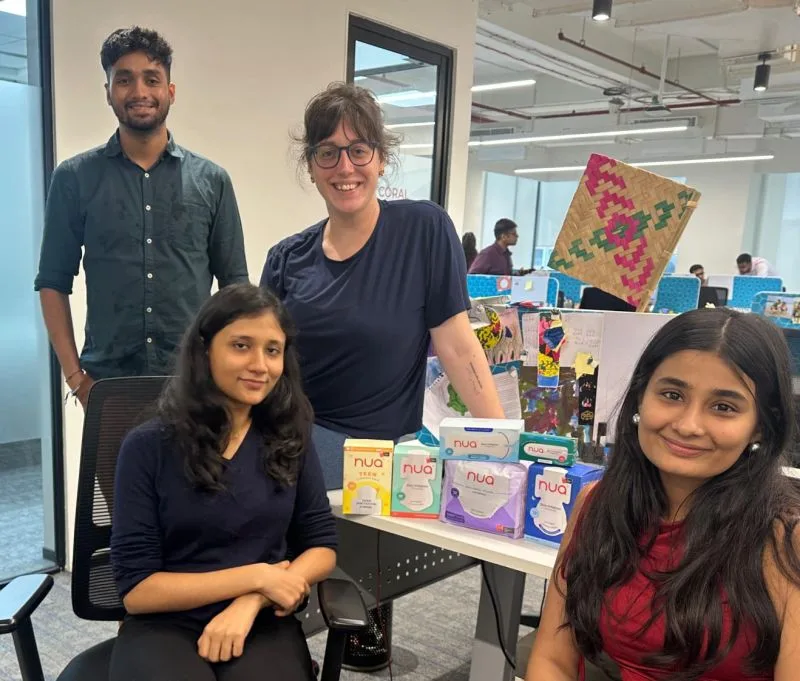
Most women’s wellness brands treat community as a marketing channel. A Facebook group. An Instagram comment section. A newsletter with a heartwarming subject line. Nua understood early that community was the actual product - that the conversations women and girls were having about their bodies were not peripheral to the business but foundational to it.
The InSync blog was part of this. So were Nua’s Instagram AMA sessions with gynaecologists and medical experts - open forums where women and girls could ask questions they would never raise with a doctor face-to-face. Questions about PCOS, mood swings, contraception, intercourse, thyroid issues, and vaginal discharge. Questions that carry the weight of accumulated silence.
The brand started conversations about daily discharge on social media - its colour, its consistency - topics that had never appeared on mainstream Indian platforms. On Instagram, women send messages to the brand. Nua writes back.
The brand is urban in its aesthetic and vocabulary, but its reach extends far beyond metros like Mumbai and Bengaluru. Women in towns with populations of a lakh have used Nua's platforms to ask questions, share experiences, and feel acknowledged by a brand that took the trouble to respond. Nua currently delivers to over 15,000 pincodes.
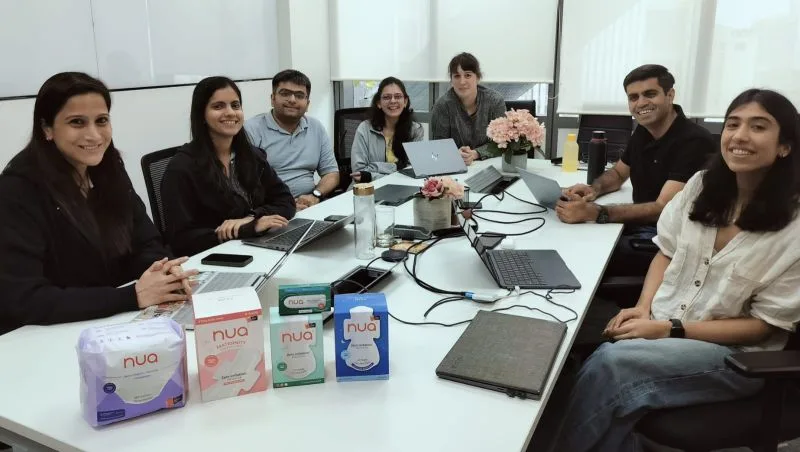
"Community building is not a one-way road. It has to be a two-way conversation." At Nua, this is an operating model, not a philosophy statement. The brand is led by a management team of Nameeta Saigal, Saloni Mayekar, cofounder Abhishek Ramanathan, and Ashish Dewan, alongside Ravi. All customer-facing functions - product development, content & community, brand marketing, digital marketing, web & D2C - are led by women. Ravi says this was never a policy decision; the best people for those roles happened to be women. Whether by design or instinct, the result is a brand structurally built to listen.
Products Built from Conversations
Nua's product development process is unusually transparent about where its ideas come from. Every new product begins with customer surveys and focus groups. The second layer is diagnostic: what are women actually finding difficult, in their bodies and in their days, that no existing product is solving well? The third brings in scientific and research expertise to validate and develop the solution. Iterations continue for the product's first year on the market, shaped by customer feedback.
Cramp Comfort, the brand's self-heating patch for period pain, is the clearest example of this process at work. Period cramps affect close to seventy per cent of menstruating women in India. The default solution has always been a hot water bag - effective, but entirely immovable. You cannot carry a hot water bag to a meeting, or wear one on the train, or use it during the school run. You can only curl up with it and wait.
Cramp Comfort changed the geometry of relief. The patch adheres to underwear, emits gentle heat for up to eight hours, and moves with the body. The warmth comes from iron powder reacting with oxygen - a principle borrowed from industrial chemistry and applied to the unglamorous reality of menstrual pain. After use, the spent patch can be composted; its ingredients can be added to soil as a fertiliser for plants. It is a product that takes seriously both the body it serves and the world around it.
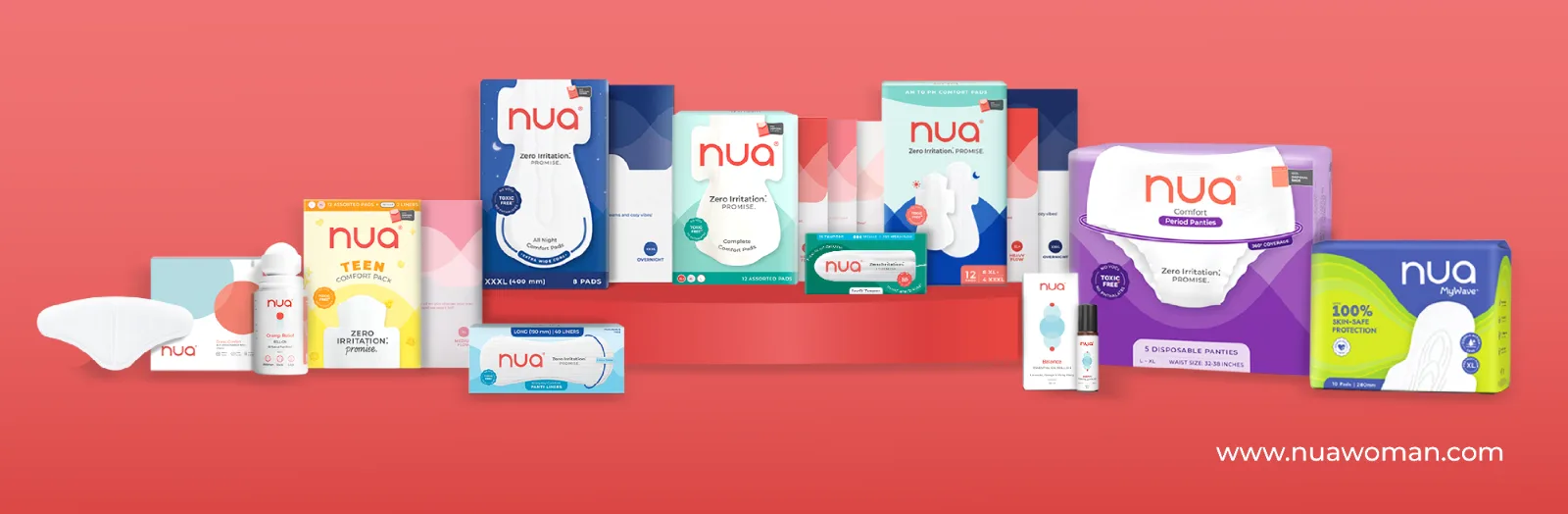
The range has expanded steadily outward from the original pad. Nua now offers night pads, disposable period panties, tampons, menstrual cups, a digital period tracker, maternity care products, a skincare range, and a daily intimate essentials range. The brand's self-description, a women’s wellness brand, not a sanitary pad company, is accurate. The pad was the starting point. The destination is a platform where women can find considered, science-backed solutions for every stage of their cycle throughout their lifetimes.
The brand serves nearly 20 lakh women and girls each month, a number Nua attributes directly to this model of building products from real conversations rather than market research alone.
"We never set out to be a pad brand. That was the first step, because periods were the most neglected and stigmatised part of women’s wellness, and the need was greatest there. But we knew women need more than pads -- they need options, they need PMS care. And we know the same cycle behind periods also influences women’s daily wellness, outside of their periods. They need care then, too. We’ve always been a brand with a 360-degree vision.”
— Ravi Ramachandran, Founder and CEO, Nua
The COVID Chapter
In 2020, when India locked down and the supply chains of ordinary life fractured, Nua faced the same reckoning as every other D2C brand. What the company chose to do with that moment said something about its character.
It partnered with the Maharashtra government's Department of Women and Child Development and the Global Shapers community to distribute menstrual products in urban slums. During the second wave, it extended support to healthcare workers. These were practical responses to a practical gap - the recognition that a period does not pause for a pandemic, and that women and girls in the most economically vulnerable circumstances were least equipped to manage the disruption.
The pandemic also accelerated Nua's growth. As Indian women increasingly shifted their purchases online, the case for a subscription-based D2C model became self-evident. Nua had built exactly for this kind of moment. Its subscriber base grew eighty-seven times between June 2020 and mid-2021. The pandemic prompted Nua to evolve the model, from a pure D2C play to a digital-first omnichannel brand, present across quick commerce apps, online marketplaces, and offline retail. Alongside the expansion came a packaging redesign that made Nua one of the first brands in the category to feature a realistic rendering of menstrual products on its own packs - a small decision that said something about how seriously the brand takes the work of normalisation.
The Capital Story
According to Entrepreneur India, Nua's funding history charts the rising credibility of women’s wellness and D2C in India. Kae Capital came in early. Lightbox Ventures followed with a Series A in 2019 - the first investment from its third fund, and an early bet on women's wellness before the category had acquired its current cultural currency. Prashant Mehta of Lightbox described Nua as something he had rarely encountered: a brand that had built intimate knowledge of its customers and was capable of using that knowledge to deliver genuine value.
The pre-Series B round in 2021 brought Deepika Padukone onto the cap table - as an investor who committed to working with Nua on new wellness solutions, not simply as a face for the brand. Also joining was Vindi Banga, former President of Global Foods and Home & Personal Care at Unilever, whose presence signalled that the brand was being taken seriously by people who had spent careers building consumer categories at global scale.
In early 2025, Nua raised a pre-Series C round. Alongside the raise, Nua disclosed something more significant than a valuation number: the brand had turned profitable. In a time when much of the D2C startup ecosystem was still trying to reconcile growth targets with financial sustainability, Nua had grown by more than 100% for two consecutive years. Distribution had expanded from a D2C website model to a digital-first omnichannel presence across all major quick commerce apps and online marketplaces, with forays into offline channels as well.
The Honest Reckoning
None of this makes Nua's journey without friction, or its work, complete.
The women’s wellness category in India has grown crowded, according to a report by WeWork India. A dozen other brands now compete for the same urban, digitally active, health-conscious customer. Against the incumbent giants - P&G's Whisper, Johnson & Johnson’s Stayfree, and Unicharm’s Sofy hold enormous market share - Nua competes at a premium, which is both its strength and its ceiling.
Branded sanitary napkins reach roughly 30% of India's menstruating population. The remaining seventy per cent - largely rural, lower-income, or both - are currently outside Nua's orbit. The brand's premium positioning does not easily translate to those markets. Its products are priced for women and girls who can afford to think of period care as a wellness decision. That is a real and growing market. It is also a partial one.
In 2025, Nua moved to close that gap. Nua MyWave, a sub-brand of sanitary pads, brings Nua's toxic-free formulation to a mass-market price point, roughly half the cost of the original, aimed directly at the consumer segment that premium positioning had placed out of reach. The infrastructure already exists: 15,000-plus pincodes, an established supply chain, deep community reach. The business case for a different price architecture is no longer just a question worth asking. It is a question the brand is already working to answer.
Why Any of This Matters
The World Economic Forum has estimated that addressing health burdens specific to women could add at least a trillion dollars to the global economy by 2040. A more granular calculation runs like this: women bleed for approximately 60,000 hours of their lives. If a meaningful portion of those hours could be made more comfortable, if pain were reduced, fatigue addressed, and the shame and silence that still surround menstruation were replaced by straightforward, accessible care, the downstream effects on productivity, education, and economic participation would be measurable.
This is the argument Nua has been making since 2017. It makes it through the accumulation of small decisions: a pad with a disposable cover, a heat patch designed to move with a body in motion, an Instagram DM answered at eleven at night. The brand has chosen to address pain rather than advertise around it.
What Nua has also done, and this deserves a sentence of its own, is shift the conversation. India in 2017 was not a country where vaginal discharge was a topic for public platforms. It is now somewhat less unspeakable in certain digital spaces. This is not Nua's achievement alone. Doctors, journalists, educators, and activists have all contributed to the change. But a brand with nearly 20 lakh women and girls in its community has done material work in normalising the vocabulary of menstrual health. That normalisation is the precondition for everything else — for women seeking treatment earlier, for girls staying in school through their periods, for employers beginning to recognise that managing a cycle is a reasonable variable in the working day.
That work is now taking three distinct shapes. The first is Flow & Tell, a community on Instagram, where women share their period experiences once a month in whatever form they choose: confessionals, comedy, open conversation. Ten months in, the community has accumulated over 36 million views. Meetups are sometimes digital, sometimes in-person, but the function is consistent: a recurring space where menstruation is simply something women talk about.
The second is Zero Club, an offline events IP running three to four times a year across Mumbai, Hyderabad, and Bangalore, with Delhi next. Events are deliberately kept small, anywhere from 20 to 80 people, sized to the activity. A yoga session runs intimate by design. The through-line is physical and mental wellness - a room built for women to step away from daily demands, not just read about doing so.
The third reaches into workplaces. Culture of Care is a brand partnership initiative that brings menstrual products into offices, restaurant washrooms, and other spaces where women are often underprepared. The premise is straightforward: period care should be where women already are.
A brand that has spent eight years asking women what they need, then building exactly that — it is, in its quiet way, a radical act.
The Personal Register
I have used Nua's products. Many women I know have. That is the kind of endorsement no press release can produce: the monthly, unremarkable, automatic act of choosing this brand over another because it has earned a small but genuine trust through consistency and care.
I have spoken with Ravi and with Liesl Goecker, Nua's Head of Content Marketing & Community. Neither conversation felt like a brand conversation. Both felt like conversations about a problem that had not been properly solved and still had a long way to go. That orientation is visible in the product, in the community, and in eight years of decisions that consistently chose the harder, slower route of actually listening.
The road ahead is less straightforward. Nua is navigating the distance between a scrappy D2C challenger and a scaled, profitable women's wellness business - with offline expansion accelerating, new price architecture to prove out, and a cap table full of people who know how to build global consumer categories. The pressures of that transition are real, and they do not always pull in the direction that got the brand here.
What Nua has built is a company that women trust in a category that historically took that trust for granted. Whether the next chapter honours that is the only question that matters.
The pad came first. The conversation came with it. The conversation, it turns out, was the point all along.

About the author
Shaili Contractor
She reads, constantly, about everything, in a way that makes her annoyingly good at spotting trends before they have names. Studied at Asian College of Journalism. Has spent 18 years turning messy briefs into brand stories people actually remember. She also spends her weekends on cleanup drives in her city because clarity matters everywhere, including the streets.
Stay in the loop
New pieces, when they're ready.
No newsletters. Just a note when something worth reading goes live.