Fun Is Not a Consolation Prize
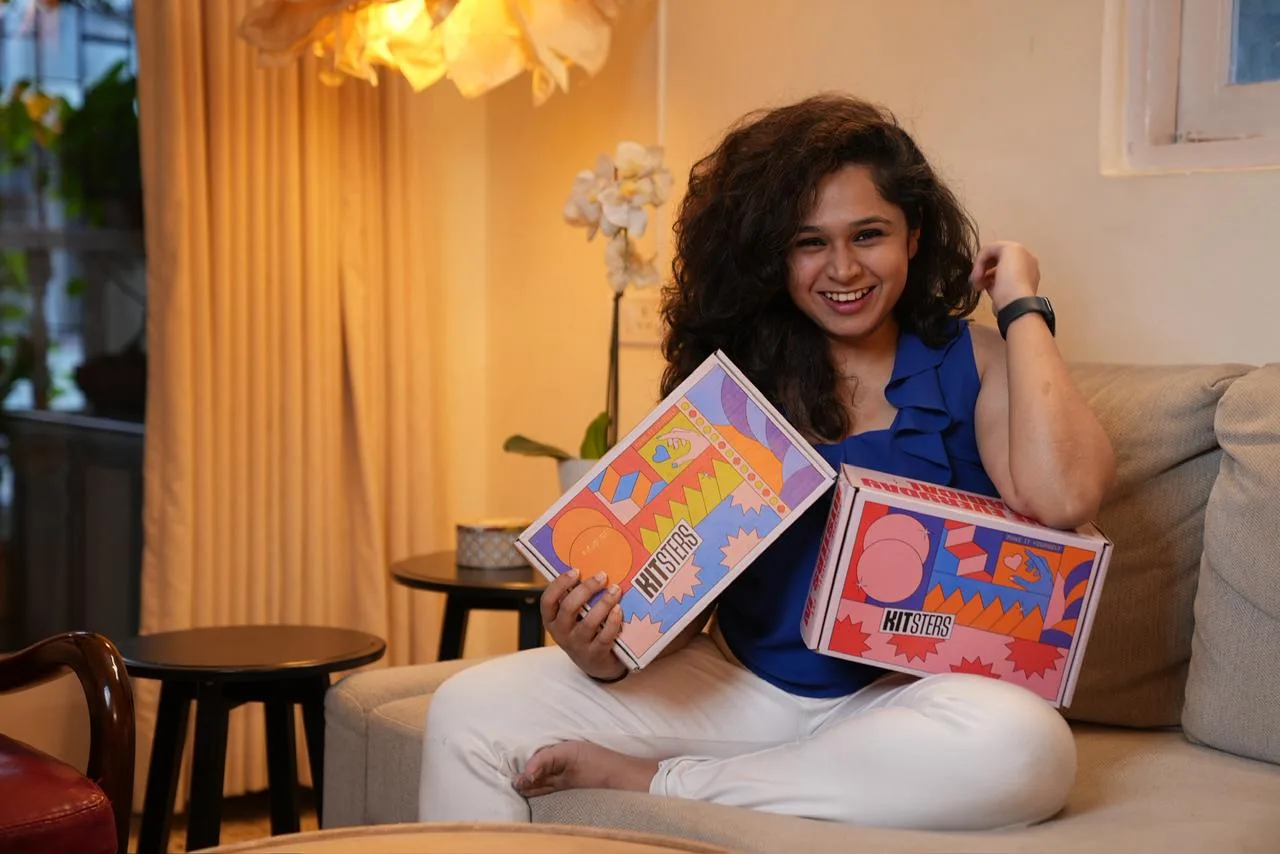
Halfway through our conversation, Nidhi Agarwal reached off-screen and held up a banknote to the camera.
It was crisp, designed, printed. It read: Republic of Kitsters. Rs 500.
She was not joking. She has spent four hours on a Sunday building the full business plan for a Caribbean island where guests pick from a menu of things to make instead of things to eat, earn Kitsters currency at resorts worldwide, and eventually accumulate enough to visit the island itself. She knows the exact location. She has the infrastructure timeline.
She has already printed the money.
We said, “This is a real-life Charlie and the Chocolate Factory.” She agreed. She’s dead serious about this.
This is Nidhi Agarwal, founder of Kitsters, India’s largest DIY kits brand for adults. Bootstrapped, 30-person team, 110-plus kits, 30,000-plus customers, run out of Mumbai and Nashik. And the Caribbean island, while distant, is also real.
But that’s not why we wanted to talk to her. We wanted to talk to her because of a refrigerator box.
It began with a box her family fridge came in
Nidhi was seven. Her family got a new refrigerator. Everyone was excited about the appliance. She was excited about the box.
It reminded us of that Calvin and Hobbes strip — the one where Calvin gets a beanie that doesn’t work, but the cardboard box it comes in becomes the source of every adventure. That was Nidhi. She built a dukaan first, complete with a proper shutter and separate entry and exit points. The next morning, she took it apart and made a spaceship. Cut it in half. Kept going, each version smaller than the last, until two weeks later there was nothing left of the cardboard.
She had found every possible version of that box before she let it go.
This pattern has not changed. She still works this way. Extract every version of a thing, then move on completely and start all over again at full intensity with the next one. It is either a gift or mildly exhausting to be around. Probably both.
A new person every morning
Growing up in a family of educators who ran a school in Nashik, Nidhi was the kind of student schools are not built for. Sharp, curious, unable to sit quietly while someone talked at a blackboard. “Every day my life was like Hannah Montana,” she told us. “I would wake up one day and I’d be an astronaut. Tomorrow I want to be a gardener. The third day, I was like a rock star.”
From Class 6 to 12, she woke up as a new person every morning. Her mother, who ran the school and could see exactly what was happening, arranged for teachers to come back in the evenings and teach her differently — through debate, through stories, through chasing a Shakespeare line further than any syllabus required. Learning was never the problem. Structure was.
She spent most of Class 12 planning to be an architect. Then her parents arranged lunch with the architect who had inspired this ambition. Halfway through the meal, Nidhi did the maths: fifteen years before she could open her own firm. And mid-conversation, the actual desire surfaced. She didn’t want to be an architect. She wanted to build a business. Architecture was just the placeholder.
Within two hours, she had researched alternatives and made a full presentation. On herself.
“I made a whole PPT. My first pitch to my mom. I told her, this is what I like. This is who I am. This is where I see my life. And this is the course that actually fits into the whole scene.”
Mass Media won. Her mom had a consistent rule: present a logical, thought-through case, and she’d hear you out. Convince her, and she’s on board. 100%.
Nidhi hated college the way she had hated school. It was the same blackboard, the same thirty students, no real conversation. Her mother, who had watched this resistance build for years, deployed the only argument she had left.
She faked a heart attack.
Nidhi tells this story with no resentment. It has been retold enough times to become just a very good story. After that, staying in college was non-negotiable. But getting to Sotheby’s in New York to study Business & Art required another pitch. Same rule. Logical case. Mom agreed.
At 18, she walked into a classroom where almost everyone else was at least a decade older. People from 30-plus nationalities. Mid-career professionals back in school out of pure interest.
“I learned for the joy of learning,” she said. “Which was, I feel, the biggest thing.”
We sat with that. Not because it was surprising, but because it was the first time in the conversation where Nidhi slowed down. Everything else came fast — ideas, pivots, timelines. But this one she held carefully. This course wasn’t going to get her a placement or a grade that mattered. She knew that when she applied. And it’s still one of the most important investments she’s made in herself.
Here was the pattern again: she didn’t go to Sotheby’s because she was supposed to. She went because it was interesting. And that distinction, which most people stop noticing somewhere around age twelve, is the thing Nidhi has refused to let go of her entire life.
The sentence that made her shut down a company
The first idea out of Sotheby’s was an app — a marketplace for artists, built for India, launched with the confidence of someone who had just spent time in New York being told she was exceptional. “I thought I was the next Zuckerberg,” she says. The Indian market had other thoughts. The app tanked. She shrugged, moved on.
She pivoted to pitching brands on artist collaborations. Working out of coffee shops. Collecting clients project by project. By 25, her agency, Fitoor (meaning obsession, which turned out to be either very apt or very ironic), had grown to 50 clients. Built from nothing.
The agency was doing fine. She was not.
The moment arrived in a routine client meeting. The client mentioned, casually, that they had switched to her from another agency because she was cheaper.
She sat with that sentence.
Stripped of everything she had told herself about craft and creativity, the value she was offering was a lower number on an invoice. She was a discount.
“I wasn’t adding any real value here.”
She shut Fitoor down in a month. Passed the clients to friends, flew back to New York. Caught trains from New Jersey into the city every day with no plan, carried a notebook, talked to strangers. Came back restored.
We asked her to stay with that moment for a second. The meeting, the sentence, the decision to shut it all down. Was there grief in it?
She thought about it. “No,” she said. “Relief.”
And that was when we started to understand how Nidhi works. The refrigerator box. Sotheby’s. Fitoor. She extracts every version of a thing and then, when the thing stops being interesting or honest, she lets it go without looking back. Most people hold on. She doesn’t.
The question was: what happens when she finds the thing she doesn’t want to let go of?
One lakh people, live
Back in Nashik, she filled her parents’ school campuses after hours — art, music, yoga, calligraphy, gardening. Within eight months, six to seven hundred people a day. Then March 2020 shut everything down overnight.
She had a domain name sitting around from earlier. Book A Workshop. She had her network of tutors. TED talks ran to eighteen minutes. She rounded up to twenty and started daily Facebook Lives: one expert, one subject, twenty minutes. Rocketry. Space tourism. Jay Oza on the cinematography of Gully Boy. Not syllabus. Not certification prep. The real talk.
Thirty episodes in, one lakh people watching live. Initial investment: Rs 20,000.
She built it into a proper platform — Netflix-style content, live workshops, third-party DIY kits as a marketplace. Then the lockdowns ended, the world remembered it had other things to do, and nobody wanted to be on another Zoom call. The platform shrank.
What didn’t shrink were the physical kits. Those kept selling. People wanted to make things with their hands at home, with decent materials, and a video showing them how. The rest had been scaffolding. The kit was the point.
The line that changed everything
She pivoted fully to DIY kits. Having no product background whatsoever, she handed the brief to art teachers. The first kit was an envelope decoration kit. They made twenty. She sold one to her nani — the first Kitsters kit ever sold. The other nineteen were given away for content. “It was the dumbest thing ever,” she says, with genuine affection for her past self.
The real first kit came over lunch with a friend at Urban Platter. A sushi kit. Chirag Kenia, the owner, backed it. Proper product, proper video. It sold. Zero to eighty kits in six months.
But the name was wrong. At Mumbai flea markets, people would pick up a kit, read “Book A Workshop,” and ask when the workshop was happening. Every time. The name was promising one thing and delivering another.
Then an advisor named Ritu David said something simple and difficult to hear:
“Learning is often forced, but fun is chosen.”
We could feel the weight of that sentence when Nidhi repeated it to us. She had built her entire professional identity around learning. Spaces, content, platforms, a whole philosophy of it. And here was someone pointing out that nobody actually wants to buy learning on a Saturday morning. They want to do something fun. Learning, if it happens, is a side effect. Pitching it as the main event was the problem.
She went back through her own history. The photography course. The acting class. Sotheby’s. The Facebook Lives. Every single one of these, she had done because it was fun. Not because it would help her career. She had been living the answer for years without naming it.
The customer she was building for was adults who refuse to accept that wonder is something you age out of. She needed a name for these people.
She called them Kitsters.
What the brand story leaves out
The business started from a single room in her Bombay house, a team of five people that slowly overtook the whole flat. Today it’s 30 people, average age still under thirty, and most of them had never built a physical product before joining. Everyone learning by doing, which is either a very Kitsters way to run a company or just the only option available.
Consider packaging. She wanted proper printed boxes. With eighty-plus kits, each needing a minimum order of a thousand boxes, she was staring at ninety thousand boxes in a warehouse, paid for upfront, for kits that might not sell. So she invented a system: three Standard Universal Boxes (SUBs) that every one of her 110-plus kits must fit into. Each gets a printed sleeve, cheap and swappable. A kit earns its own dedicated packaging only when its sales cross a threshold.
This is the kind of thinking that never makes it into a brand story. And it’s precisely what makes the brand story possible.
Two of the bestsellers came from her husband. He suggested the gola kit and the cotton candy kit as jokes. Both are hits. The gola kit is currently out of stock with ten-plus enquiries per day. She mentions his contribution with the easy pleasure of someone who is glad to be working alongside the right person. He is also, she says, the person who has shot down more of her ideas than anyone else. She trusts him because of this.
And here is something that tells you more about Nidhi than almost anything else we could write: she hated accounting in school. Found it dull, mechanical, removed from anything that felt alive. Now, running Kitsters, she does her accounts every day and looks forward to it.
Every number is a step closer to what she’s building.
She already has the money printed
Ask Nidhi where she’s taking all of this, and she will tell you, without any self-consciousness: the Republic of Kitsters. Its own currency. Experience resorts. Creative spaces around the world. Eventually, the Caribbean island.
She says this the way someone talks about something they have already half-imagined into existence. No hedging, no qualifier. She has been telling herself this story long enough that it has the texture of memory rather than ambition.
The gola kit is a good way to understand why we believe her. This is a kit that lets adults make crushed ice street snacks at home. More than ten people ask about it every single day and there’s no stock. Nidhi told us this with something close to delight.
But it’s not really about the gola. It’s about being seven years old on a summer pavement with a few rupees and nothing more pressing to do than stand there and eat ice. Kitsters sells that feeling back to adults who forgot they missed it. The kit is just the delivery mechanism.
“Someone opens the kit, creates something with their hands, and feels that small burst of magic. And honestly, that feeling makes everything completely worth it.”
What she left us with
There’s a version of Nidhi’s story that’s about grit. The failed app, the agency she shut down, the platform that shrank, the pivot to physical products. Three businesses closed before the fourth worked. You could tell that story, and it would be true, and it would sound like every founder narrative you’ve already read.
But that’s not what we saw.
What we saw was a person who has known since age seven what she wants to feel, and has spent twenty years finding the right container for it. The refrigerator box, the Sotheby’s classroom, the Facebook Lives, the kits. Each one was a version of the same thing: making something with your hands and feeling, for a moment, that the world is more interesting than it was before.
She’s still finding new versions of it. And from the look on her face when she held up that currency note, she’s nowhere close to done.

About the author
Shaili Contractor
She reads, constantly, about everything, in a way that makes her annoyingly good at spotting trends before they have names. Studied at Asian College of Journalism. Has spent 18 years turning messy briefs into brand stories people actually remember. She also spends her weekends on cleanup drives in her city because clarity matters everywhere, including the streets.
Stay in the loop
New pieces, when they're ready.
No newsletters. Just a note when something worth reading goes live.